
Medical Dermatology
Basal Cell Carcinoma Treatment in Peachtree City, GA
Basal cell carcinoma (BCC) is the most common cancer in humans — about 8 in 10 skin cancers are basal cell — and one of the most treatable. It grows slowly and almost never spreads to other parts of the body, but it does not stop growing on its own, and the longer it grows, the more skin has to be removed to clear it. That makes the math simple: found early, a BCC is usually a small procedure with a small scar. We handle the whole path here — same-visit biopsy, pathology read in-house, and fellowship-trained Mohs surgeons when the location calls for one.
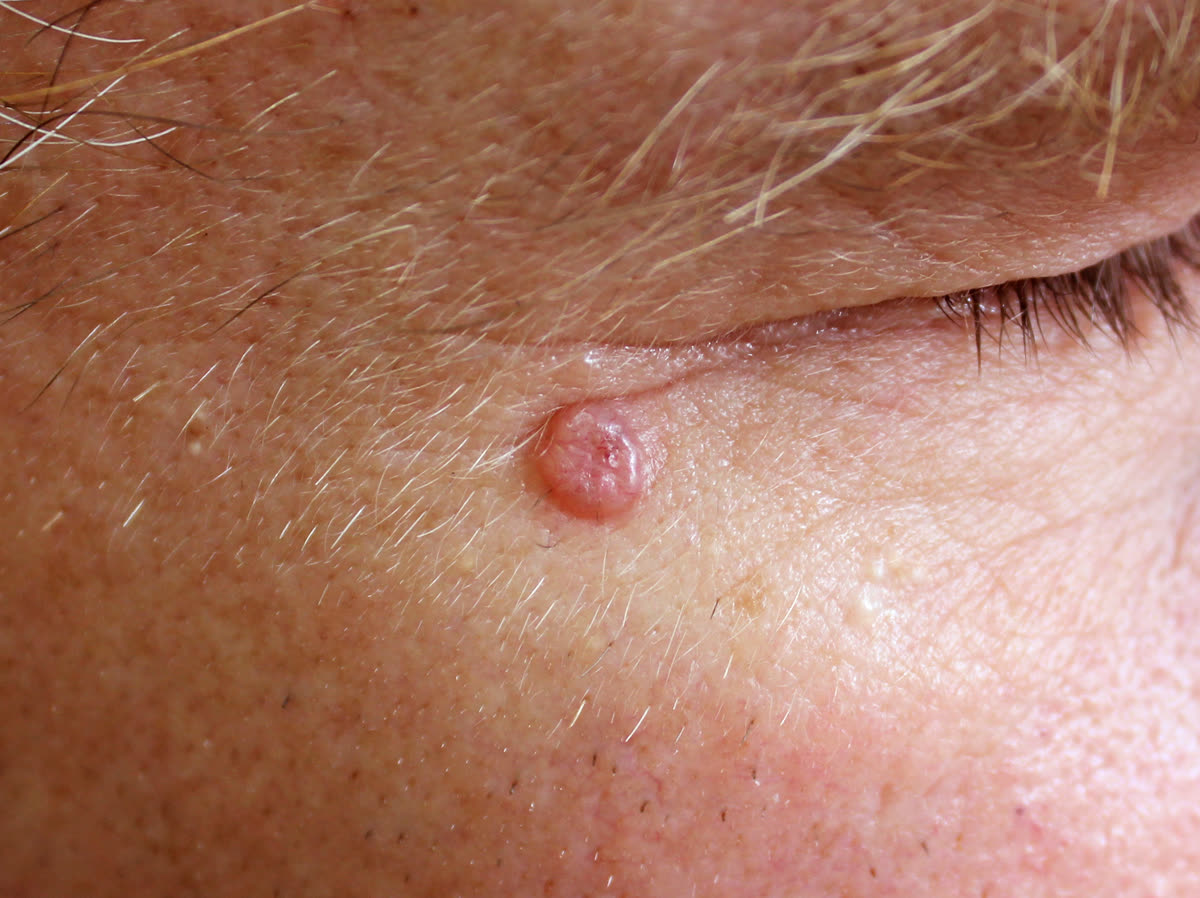
What basal cell carcinoma looks like
BCC is a shape-shifter, and most show up on sun-exposed skin. Have a spot examined if you notice:
- A pearly or waxy bump — pink, flesh-colored, or translucent, sometimes with a rolled edge
- A sore that won't heal — or one that heals, then bleeds, crusts, and opens again over weeks
- A flat pink or red patch — slowly growing, easy to mistake for eczema or a patch of dry skin
- Tiny visible blood vessels — fine red lines threading across the surface of a bump
- A scar-like area — shiny, white, or waxy skin with no injury to explain it
What basal cell carcinoma is
BCC starts in the basal cells — the small cells at the bottom of the epidermis that constantly produce new skin. Years of ultraviolet exposure damage their DNA, and eventually one of them starts growing without the off switch. That's why BCC favors the skin that has seen the most sun: the nose, cheeks, ears, forehead, scalp, neck, and shoulders, and the backs of the hands. It can appear on the trunk or legs too, but the face leads by a wide margin — which matters, because the face is exactly where you want treatment to be as small and precise as possible.
The people who get it most are the people the Georgia sun has worked on longest: fair skin that burns easily, light eyes or hair, decades of outdoor work or golf or yard time, a history of tanning bed use. Risk also climbs with age, with a weakened immune system (organ transplant recipients in particular), with prior radiation treatment to the skin — and, most of all, with having had a BCC before.
Slow-growing is not the same as harmless
Here is the honest picture. BCC almost never metastasizes — spread to distant organs is genuinely rare. What it does instead is keep growing where it is: wider and deeper, destroying the normal skin around it, and over years it can work into cartilage, nerve, or bone — a real problem on a nose or an ear. An untreated BCC does not dry up and fall off. It just quietly gets bigger.
That is the whole argument for early treatment: the size of the repair is set by the size of the cancer, not by us. A BCC treated at a few millimeters usually means a short procedure and a scar that fades into a line. The same cancer ignored for a few years can mean a significant reconstruction. Nothing about a BCC diagnosis is an emergency — but every month it grows is skin that has to be removed later.
How we diagnose it
A provider examines the spot — often with a dermatoscope, a polarized magnifier that reveals the vessel patterns and structures BCCs tend to show — and if it looks suspicious, it gets biopsied the same visit: quick numbing, a small sample, a bandage. The sample is read on-site through our own dermatopathology lab by a board-certified dermatopathologist, which means faster answers and a pathologist your surgeon can actually talk to.
The biopsy report does more than say yes or no. It identifies the subtype — superficial, nodular, or infiltrative — and that detail drives which treatment makes sense, because a thin superficial BCC and a deeply infiltrative one are very different problems.
Treatment options
BCC has a full menu of effective treatments, and the right one depends on the subtype, size, location, and you:
- Mohs micrographic surgery — the usual recommendation for BCCs on the face, head, and neck, and for recurrent or ill-defined tumors. The surgeon removes the cancer in thin layers and checks 100% of the margin under the microscope while you wait, so the cancer is confirmed gone before the repair — the highest cure rate of any option while sparing the most normal skin. Our Mohs surgeons are fellowship-trained and repair the site the same day.
- Surgical excision — the workhorse for BCCs on the trunk, arms, and legs: the cancer is removed with a margin of normal skin, closed with stitches, and the margins are confirmed by pathology.
- Electrodesiccation and curettage (ED&C) — a quick office procedure that scrapes and cauterizes select small, superficial, low-risk BCCs.
- Prescription topical therapy — for select superficial BCCs, a several-week course of a prescription cream can clear the tumor without surgery, with a follow-up exam to confirm it worked.
- Radiation therapy — an option in select situations, such as patients who can't undergo surgery.
We'll walk through the options that fit your biopsy result plainly — including what each one involves and what the site will look like after.
After a basal cell carcinoma
The strongest risk factor for a basal cell carcinoma is having had one: after a first BCC, roughly 4 in 10 people develop another within five years. The sun damage behind the first one is already banked in the surrounding skin — so the goal shifts from if to finding the next one small.
That means a regular full-body exam schedule with us, self-checks between visits for the same warning signs that brought you in (pearly bumps, sores that won't heal, scaly pink patches), and real sun protection going forward: broad-spectrum SPF 30+ on exposed skin daily, hats and shade through Georgia summers, and no tanning beds. Prevention won't undo old damage, but it stops the meter from running.
Related: Squamous Cell Carcinoma · Melanoma · Skin Cancer & Mohs Surgery · Actinic Keratosis · Moles & Spot Checks · Skin Cancer
This page is general education, not a diagnosis — see a dermatologist in Peachtree City about your specific skin concern.
Common questions
Rarely. BCC almost never spreads to other organs. The trouble it causes is local — it keeps destroying the skin it grows through — which is why it's taken seriously and treated, but for most patients a BCC is a very fixable problem.
It's not an emergency, and it's not a someday. Most BCCs grow slowly, but every month adds size, and size determines how big the procedure and the scar will be. Once a biopsy confirms BCC, we schedule treatment promptly — think weeks, not months.
It depends on where the cancer is and what the biopsy shows. BCCs on the face, head, and neck are usually best treated with Mohs — highest cure rate, smallest scar — while many BCCs on the trunk or limbs do fine with standard excision. We'll recommend based on your pathology, not a default.
Honestly: it depends on the size of the cancer at treatment, which is the best argument for coming in early. Mohs spares as much normal skin as possible and the site is repaired the same day; most scars settle into a thin line that fades over months.
For select superficial BCCs, yes — a prescription topical used for several weeks can clear the tumor, with a follow-up exam to confirm. It's not appropriate for deeper or more aggressive subtypes, which is why the biopsy result decides, not preference alone.
Your odds are real — roughly 4 in 10 people develop a second BCC within five years of the first. That's not a reason for alarm; it's the reason we'll put you on a regular skin exam schedule, so number two gets caught even smaller than number one.
Ready to have it looked at?
Same-day and next-day appointments are often available · 4.8 from 360+ Google reviews. Mon–Fri · 7:30am–5:00pm.