
Medical Dermatology
Melanoma Diagnosis & Treatment in Peachtree City, GA
Melanoma is the most serious skin cancer — far less common than basal or squamous cell, but responsible for most skin cancer deaths because it can spread. The counterweight is just as real: found early, melanoma is highly curable — American Cancer Society figures put five-year survival for melanoma still localized to the skin at about 99%. Everything about melanoma care flows from that one fact. Find it early. That is what skin exams, mole mapping, and the ABCDEs below are for — and it's why a changing mole gets a same-day or next-day slot here, not a spot on next month's calendar.
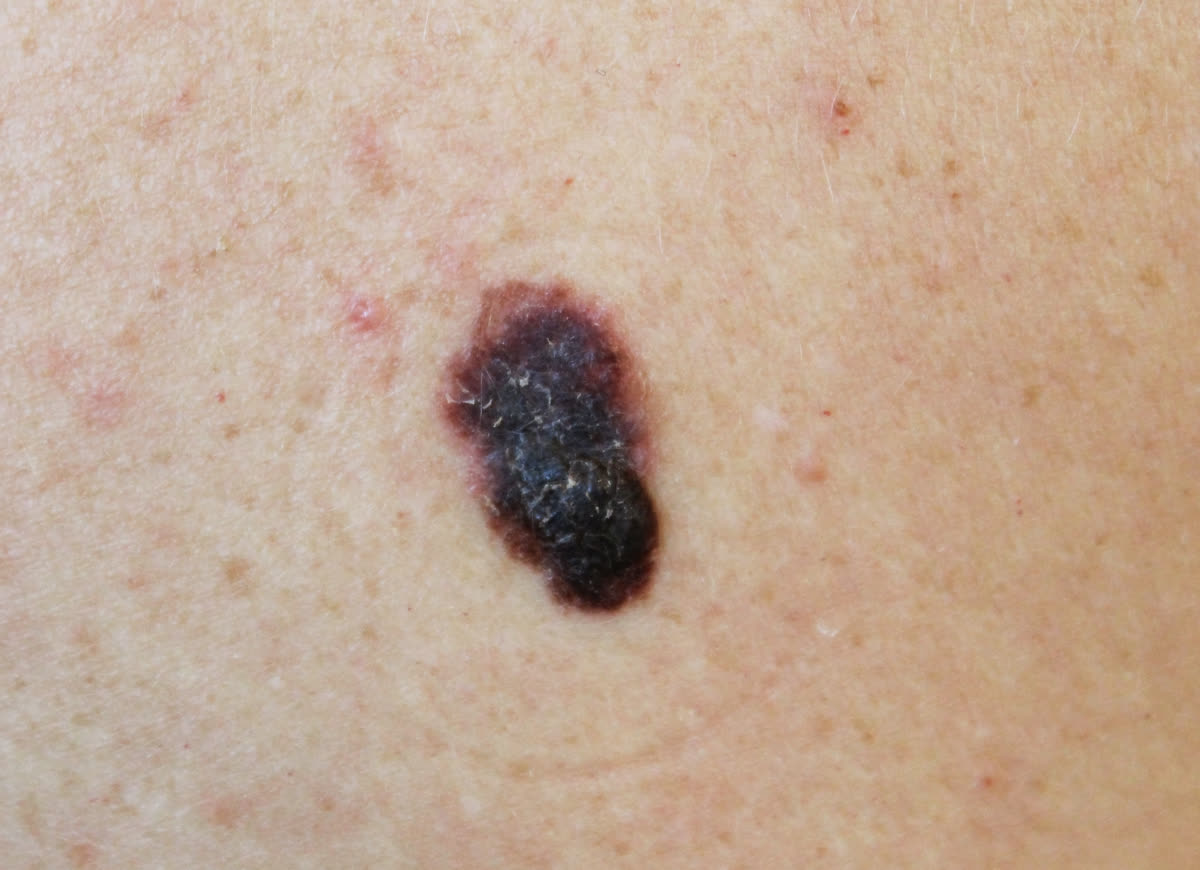
The ABCDEs of melanoma
Melanoma often looks like a mole that broke the rules. Come in if a spot shows any of these:
- A — Asymmetry — one half doesn't match the other
- B — Border — edges that are ragged, notched, or blurred
- C — Color — more than one shade — browns and black, or patches of pink, red, white, or blue
- D — Diameter — larger than a pencil eraser (6mm), though melanomas can be smaller
- E — Evolving — changing in size, shape, or color — or starting to itch, bleed, or simply stand out from your other moles
What melanoma is, and where it shows up
Melanoma is cancer of the melanocytes — the pigment cells that give skin its color. It can start inside an existing mole, but more often it appears as a new dark spot on previously normal skin. It typically looks like a brown or black mole with uneven borders and varying colors, though not all melanomas are dark: some are pink or flesh-colored, which is why different from your others matters more than any single shade. And unlike most cancers, melanoma is common in young adults as well as older ones.
It has favorite locations — the upper back in both men and women, and the lower legs in women — but it also hides in places people never think to check: the scalp under hair, the soles of the feet, the palms, under fingernails or toenails (a new dark streak), and between the toes. In people with darker skin tones melanoma is less common but more likely to appear on exactly those overlooked sites — palms, soles, and nails. This is why a proper skin exam covers all of you, not just the spots you can see in a mirror.
Who is at higher risk
Anyone can get melanoma, but some people need to watch more closely:
- Family history — a parent, sibling, or child with melanoma raises your risk meaningfully.
- Many moles, or atypical ones — people with numerous moles or atypical (dysplastic) moles carry higher risk and benefit most from mapping and regular exams.
- Tanning beds — indoor tanning raises melanoma risk, and the younger and heavier the use, the worse the math.
- Sunburn history — blistering sunburns, especially in childhood, leave a lasting mark on risk.
- Fair skin — light skin, red or blond hair, freckling, and skin that burns rather than tans.
- A previous melanoma or other skin cancer, or a weakened immune system.
Higher risk isn't fate — it's a screening schedule. If any of these describe you, an annual full-body exam is the single most useful habit you can build.
Staging in plain language: depth drives everything
When a melanoma is diagnosed, the most important number on the report is its depth — how far, in millimeters, it has grown down into the skin. Depth drives everything: how much surgery is needed, whether lymph nodes should be checked, and what the outlook is.
A melanoma caught while it's still thin — confined to the top layers — is usually cured with an outpatient excision, and the numbers back that up: five-year survival for localized melanoma is about 99% per the American Cancer Society. Once melanoma grows deeper or reaches lymph nodes or beyond, treatment gets more involved and the odds get harder. Here's the part worth internalizing: depth is largely a function of time. A changing mole examined this month and the same mole examined next year can be two very different diagnoses — which is why "let's keep an eye on it" is the wrong plan for a spot that's already changing.
How melanoma is diagnosed here
It starts with an exam — a spot check for one worrisome mole, or a full-body screening — using a dermatoscope, a polarized magnifier that reveals pigment patterns the naked eye can't see. Anything suspicious is biopsied the same visit, and the sample is read on-site through our own dermatopathology lab by a board-certified dermatopathologist. Melanoma can be a genuinely difficult call under the microscope, and having the pathologist down the hall from the treating provider — not across the country — is a real advantage.
For patients with many moles or atypical ones, we offer mole mapping: photographic tracking that makes change obvious from visit to visit instead of relying on anyone's memory. If the biopsy confirms melanoma, the report's depth and features set the plan — and we walk you through exactly what they mean.
Treatment, and the years after
For early melanoma, the mainstay of treatment is surgical excision with a margin — removing the melanoma along with a measured border of normal skin, sized to the tumor's depth. For many patients that's the entire treatment, done as an outpatient procedure. For deeper melanomas, we may recommend checking the nearest lymph node (a sentinel lymph node biopsy) and coordinate that step with surgical colleagues. When melanoma is advanced, care is co-managed with oncology — and it's worth knowing that immunotherapy and targeted medicines have substantially improved the outlook for advanced disease in recent years.
After any melanoma, surveillance becomes part of life — and it works. You'll be on a full-body exam schedule that's more frequent at first and then settles into a long-term rhythm, with monthly self-checks between visits. Because melanoma runs in families, your parents, siblings, and children should get screened too. And the sun rules become permanent: broad-spectrum SPF 30+ daily, hats and shade, and no tanning beds — ever.
Related: Basal Cell Carcinoma · Squamous Cell Carcinoma · Skin Cancer & Mohs Surgery · Actinic Keratosis · Moles & Spot Checks · Skin Cancer
This page is general education, not a diagnosis — see a dermatologist in Peachtree City about your specific skin concern.
Common questions
It depends almost entirely on how early it's found. Melanoma still localized to the skin has a five-year survival of about 99% per the American Cancer Society; melanoma that has spread is a much harder fight. That gap is the entire case for skin exams and acting on changing moles quickly.
Yes — the scalp, the soles of the feet, the palms, under nails, even between toes. Sun exposure is the biggest driver of melanoma, but not the only one, which is why a full-body exam checks the places you can't see and never think about.
Most are from injury, but a new dark streak — especially in a single nail, or with pigment spreading onto the surrounding skin — can be a nail melanoma and deserves a prompt exam. It's a quick look that settles the question.
No — most melanomas appear as a new spot on previously normal skin. A changing mole is still a classic warning sign, and a brand-new mole appearing after your 20s is worth an exam on principle.
Most early melanomas are treated completely with surgery alone — no drugs at all. When more than surgery is needed, treatment today usually means immunotherapy or targeted medicines managed together with an oncologist, and we coordinate that care rather than handing you off.
Your risk is higher, so get ahead of it: a yearly full-body exam (sometimes more often), mole mapping if you have many moles, monthly self-checks using the ABCDEs, disciplined sun protection, and no tanning beds. Family history you can't change; when it's found, you can.
Ready to have it looked at?
Same-day and next-day appointments are often available · 4.8 from 360+ Google reviews. Mon–Fri · 7:30am–5:00pm.