
Medical Dermatology
Squamous Cell Carcinoma Treatment in Peachtree City, GA
Squamous cell carcinoma (SCC) is the second most common skin cancer — about 2 in 10 skin cancers are squamous cell — and the great majority are cured with a straightforward procedure. It earns more respect than a basal cell, though: a small minority of SCCs can spread if they're ignored, which is why the plan here is built for speed — a biopsy at the visit, pathology read in-house, and treatment scheduled promptly. Caught early, SCC is a small problem handled in one office.
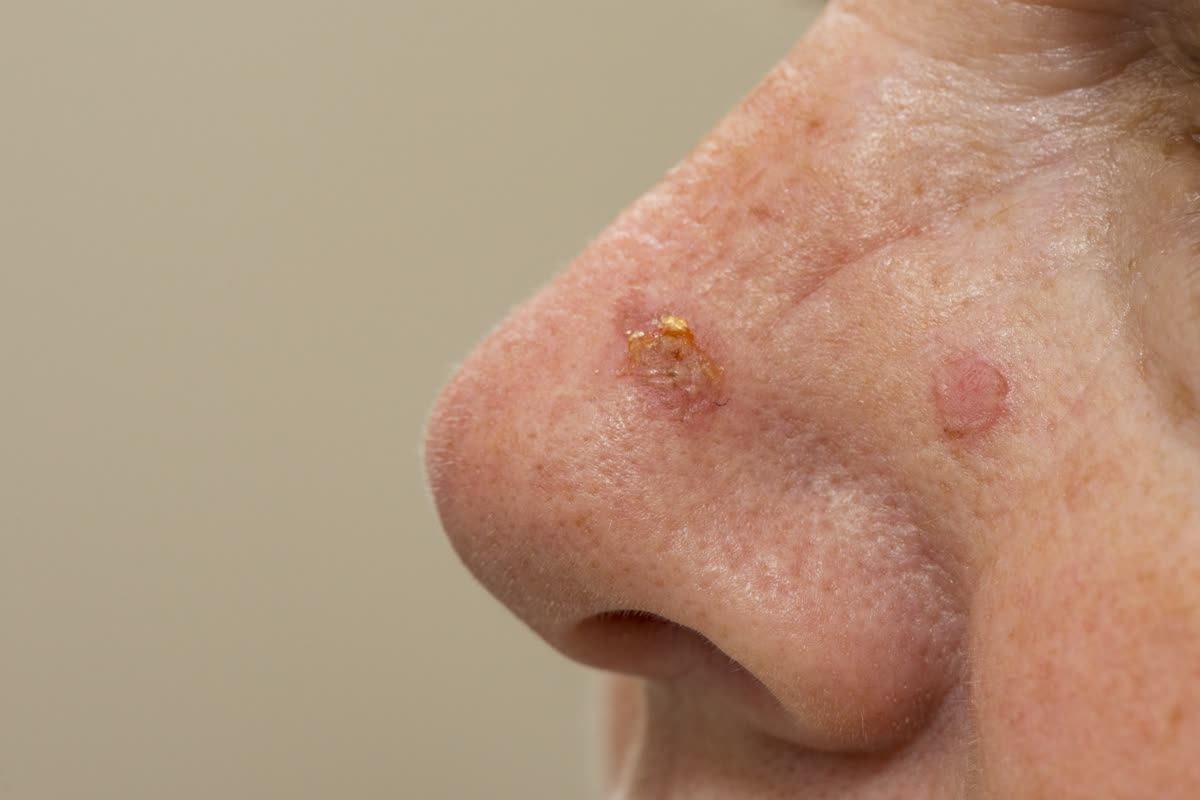
What squamous cell carcinoma looks like
SCC usually appears on skin that has taken decades of sun. Have a spot examined if you notice:
- A rough, scaly patch — thickened or crusted, sometimes bleeding, on sun-worn skin
- A firm red bump — dome-shaped, sometimes tender, growing over weeks to months
- A sore that won't heal — or an ulcer that keeps crusting over and reopening
- A wart-like growth — raised and crusted, occasionally bleeding
- A new crusted spot on the lip or ear — locations we always take seriously
What squamous cell carcinoma is
SCC arises from squamous cells — the flat cells that make up most of the epidermis — after years of ultraviolet damage, and it mostly affects people with fair complexions who have spent real time in the sun. It favors the most exposed real estate: the face, ears, lips, scalp (especially where hair has thinned), neck, backs of the hands, forearms, and lower legs. Less commonly, SCC can also develop in old scars, burns, or chronic wounds, and in skin that has had radiation.
Size varies widely — from a small crusted bump to a broad scaly plaque — and tenderness is common enough that a sore, growing spot should never be written off as just irritation.
Actinic keratosis: the warning it usually sends
Many SCCs don't appear out of nowhere — they grow out of actinic keratoses (AKs), the rough, scaly pre-cancerous patches that show up on sun-exposed skin. An estimated 40% of squamous cell carcinomas originate as AKs, and even a trained eye can find it nearly impossible to tell an AK from an early SCC without a biopsy.
That's why we treat AKs rather than watch them: clearing the pre-cancer is the closest thing skin cancer care has to true prevention. If you have scaly patches that keep coming back on your face, scalp, or forearms, that's worth a visit before anything declares itself.
The honest part: some SCCs can spread
Most squamous cell carcinomas are cured with local treatment, full stop. But unlike basal cell carcinoma, a minority of SCCs can spread — usually first to nearby lymph nodes — and certain features raise the stakes: tumors on the lips or ears, tumors that are large, deep, fast-growing, or recurrent, tumors arising in scars or chronic wounds, and SCC in immunosuppressed patients. Organ transplant recipients in particular develop SCC far more often, and their tumors can behave more aggressively.
None of that is cause for panic — it's cause for promptness. Treating an SCC while it's small and shallow is what keeps it a skin problem rather than a lymph node problem, and it's why we don't sit on suspicious scaly spots.
How we diagnose it
Diagnosis starts with an exam and, for anything suspicious, a same-visit biopsy: quick numbing, a small sample, a bandage. The sample is read on-site through our own dermatopathology lab by a board-certified dermatopathologist — faster answers, and a pathologist your treating provider can talk to directly.
The report tells us what we're dealing with: whether the SCC is still confined to the surface (in situ) or invasive, and how aggressive it looks under the microscope. Those details, plus the location, set the treatment plan.
How we treat it
Treatment is matched to the tumor and the spot:
- Mohs micrographic surgery — for SCCs on the face, head, and neck and for higher-risk tumors. The cancer is removed in thin layers with the full margin checked under the microscope the same visit — the highest cure rate while sparing the most normal skin, with same-day repair by our fellowship-trained Mohs surgeons.
- Surgical excision — standard for many SCCs on the trunk and limbs: removal with a margin of normal skin, confirmed by pathology.
- Electrodesiccation and curettage (ED&C) — an office procedure for select small, superficial, low-risk tumors, including some SCC in situ.
- Radiation therapy — used in select cases, such as patients who can't undergo surgery or as an addition for certain high-risk tumors.
Afterward, prevention does real work: daily broad-spectrum SPF 30+, hats and shade, no tanning beds, treating actinic keratoses before they evolve, and a regular full-body exam schedule — especially if you're fair-skinned, have had a skin cancer before, or take immunosuppressing medication.
Related: Basal Cell Carcinoma · Melanoma · Skin Cancer & Mohs Surgery · Actinic Keratosis · Moles & Spot Checks · Skin Cancer
This page is general education, not a diagnosis — see a dermatologist in Peachtree City about your specific skin concern.
Common questions
Usually not — the large majority are cured with local treatment. A small minority can spread, most often from the lips or ears, from large or fast-growing tumors, or in people with weakened immune systems. That risk is exactly why SCC gets treated promptly instead of watched.
Both come from sun damage and both are common. Basal cell almost never spreads — it's locally destructive. Squamous cell occasionally can, which moves it up the priority list. The treatments overlap heavily, and both are highly curable when caught early.
Yes — an estimated 40% of squamous cell carcinomas start as actinic keratoses, and telling an AK from an early SCC without a biopsy is nearly impossible even for a trained eye. Treating AKs is prevention, not perfectionism.
Significantly. Immunosuppressed patients — organ transplant recipients especially — develop SCC far more often, and it can behave more aggressively. If that's you, you belong on a regular full-body exam schedule with a low threshold for biopsy, and we'll set that up.
For SCCs on the face, head, and neck, or with higher-risk features, usually yes — it offers the highest cure rate with the smallest scar. Many SCCs on the body do well with standard excision. The biopsy result and location drive the recommendation.
It keeps growing deeper and wider, can ulcerate and become painful, and over time the risk of spread to nearby lymph nodes rises. Treated early, SCC is typically a single, small procedure — waiting is what makes it complicated.
Ready to have it looked at?
Same-day and next-day appointments are often available · 4.8 from 360+ Google reviews. Mon–Fri · 7:30am–5:00pm.